Extending detekt for Android at JET

This post was originally published on the Just Eat Takeaway blog
For some time now, the JET Android Consumer App has been heavily relying on detekt for static code analysis.
The default rules detekt comes with are, by nature, generic enough to serve most projects. But there are times when we need to be more specific in order to:
- Help steer the “ship” in the right direction
- Remove the need of humans catching issues at review time
Let’s have a look at a specific rule, then.
Supporting edge-to-edge enforcement#
Apps are edge-to-edge by default on devices running Android 15 if the app is targeting Android 15.
Most devs would not be aware of this change, neither are they expected to be. To convey this, we want to accomplish two things:
- Make sure all existing classes extending
AppCompatActivityare callingenableEdgeToEdge - Prevent any future activities from being created without it
Detekt has a very in-depth API, but simply reading the text of a file with override fun visitKtFile does the trick here.
class EnableEdgeToEdgeRule(config: Config) : Rule(config) {

    override val issue = Issue(
        javaClass.simpleName,
        Severity.Defect,
        EDGE_TO_EDGE_MESSAGE,
        Debt.TWENTY_MINS
    )

    override fun visitKtFile(file: KtFile) {
        super.visitKtFile(file)

        if (file.text.contains("AppCompatActivity()") && !file.text.contains("enableEdgeToEdge()")) {
            report(
                CodeSmell(
                    issue = issue,
                    entity = Entity.from(file),
                    message = EDGE_TO_EDGE_MESSAGE
                )
            )
        }
    }
}

internal const val EDGE_TO_EDGE_MESSAGE = "AppCompatActivity should use enableEdgeToEdge as it is enforced when targeting Android 15"
EnableEdgeToEdgeRule.kt
How does this even work?#
All the rules, like the one above, are placed inside a module called detekt-custom-rules.
It is a plain library project, relying on the detekt plugin and the detekt-api library. Its job is to provide the custom rules to the rest of the project.
plugins {
    kotlin
    id("io.gitlab.arturbosch.detekt")
}

dependencies {
    compileOnly(libs.kotlin)
    compileOnly("io.gitlab.arturbosch.detekt:detekt-api:<version>")
}
build.gradle.kts
Defining the rule set#
Rules are added in an implementation of RuleSetProvider:
class JetRuleSetProvider : RuleSetProvider {
    override val ruleSetId: String = "JetRuleSet"

    override fun instance(config: Config): RuleSet {
        return RuleSet(
            ruleSetId,
            listOf(
                EnableEdgeToEdgeRule(config)
            ),
        )
    }
}
JetRuleSetProvider.kt
Registering the provider#
Detekt uses the ServiceLoader pattern to collect all instances of RuleSetProvider interfaces.
The resources/META-info/services/io.gitlab.arturbosch.detekt.api.RuleSetProvider file has only one line in it, pointing to the implementation:
com.jet.detektcustomrules.JetRuleSetProvider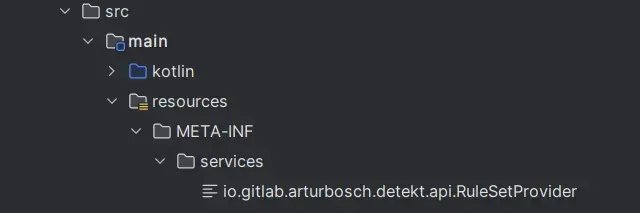
Sharing this to the rest of the project#
- Apply the
detekt-custom-ruleslibrary via thedetektPluginssyntax - Point detekt to the yml file where all the rules are defined.
dependencies {
    detektPlugins(project(":detekt-custom-rules"))
}

detekt {
     config.setFrom(file("config/detekt/detekt.yml"))
}
build.gradle.kts
The detekt.yml file#
JetRuleSet:
    EnableEdgeToEdgeRule:
        active: true
detekt.yml
In action#
Locally running <module>:detekt on a module with an “offending” activity, the HTML report confirms that the rule is working ok.
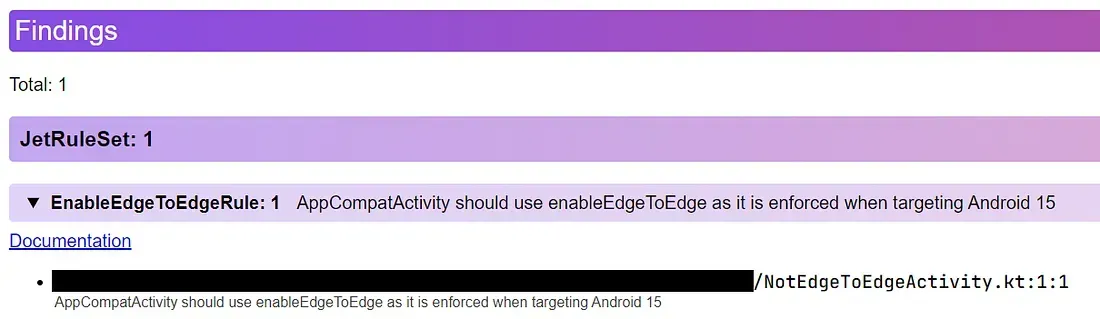
For CI, danger-kotlin is used to post this exact message as a comment on pull requests.
Unit testing rules#
It’s fair to say that most devs are not very familiar with the detekt APIs. And while detekt is powerful, it’s also quite arcane.
It’s no surprise that it takes a lot of attempts to write a new rule that works as intended. Fortunately, the testing library allows for quick iteration.
class EnableEdgeToEdgeRuleTest {
    @Test
    fun `should report when edgeToEdge is not used`() {
        val code = """
            class A : AppCompatActivity() {
                fun foo() {

                }
            }
        """
        val findings = EnableEdgeToEdgeRule(Config.empty).compileAndLint(code)
        assertEquals(
            findings[0].message,
            EDGE_TO_EDGE_MESSAGE
        )
    }
}
EnableEdgeToEdgeRuleTest.kt
But wait, there is more#
The JET Android app has plenty more rules like this one. For example:
- Preventing usages of
android.util.LogandGlobalScopein favour of custom implementations - Preventing activities overriding
onBackPressed(), in order to support predictive back animations - Enforcing usage of custom annotations for Dagger2
- And a few other esoteric rules that would make no sense for people outside this project 😅

Deprecating ourselves#
The road to removing the need for human reviewers is nothing new. Lint has been doing that for years now, as well as 100s of other tools out there.
There is only so much detekt can do since the rules themselves are written, hastily most of the time, by humans. Still, it’s a much better alternative than relying on the right person catching issues at review time.
Hope you found this somewhat useful.
Cheers 👋